

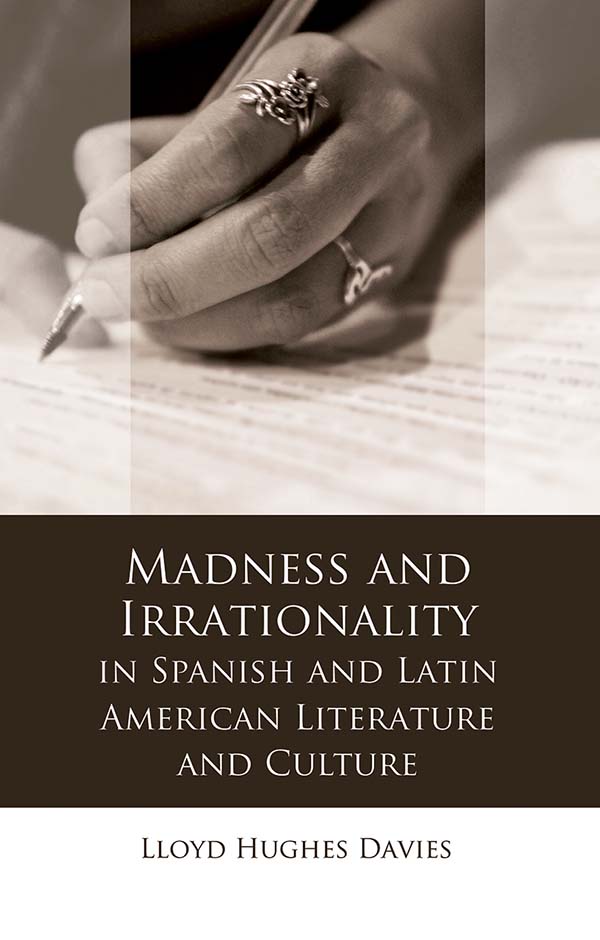
Madness and Irrationality in Spanish and Latin American Literature and Culture
Awdur(on) Lloyd Davies
Iaith: Saesneg
Dosbarthiad(au): Literary Studies
Cyfres: Iberian & Latin American Studies
- Mehefin 2020 ·216x138mm
- · Clawr Meddal - 9781786835758
- · eLyfr - pdf - 9781786835765
- · eLyfr - epub - 9781786835772
This is the first monograph to consider the significance of madness and irrationality in both Spanish and Spanish American literature. It considers various definitions of madness and explores the often contrasting responses, both positive (figural madness as stimulus for literary creativity) and negative (clinical madness representing spiritual confinement and sterility). The concept of national madness is explored with particular reference to Argentina, where the country's vast expanses have been seen as conducive to madness, while the urban population of Buenos Aires is especially dependent on psychoanalytic therapy. The discussion considers both the work of lesser-known writers such as Nuria Amat, whose personal life is inflected by madness, and that of larger literary figures such as Jose Lezama Lima, whose poetic concepts are suffused with the irrational. The conclusion draws attention to the other side of reason as a source of possible originality in a world dominated by the tenets of logic and conventionalised thinking.
Contents
Acknowledgements
1.Introduction
2.The Concept of National Madness: the Argentine Paradigm
3.'Voices in the Wilderness': Conquest and Counter-conquest in Abel Posse
4.Morality, Madness, Memory: Royal Women in Fernando del Paso (Noticias del Imperio) and Lourdes Ortiz (Urraca).
5.Crime, Madness, Art: Alejandra Pizarnik and Manuel Vazquez Montalban
6.Books about Books: Ruiz Zafon's La sombra del viento and Perez-Reverte's El club Dumas
7.Self-Consciousness and Schizophrenia: the Literary World of Nuria Amat
8.Joy in Paradise: Jose Lezama Lima
9.Desert, Delirium, Digression: the Fictional Worlds of Juan Jose Saer
10.Conclusion
Bibliography
Index