

Consuming Narratives
Gender and Monstrous Appetites in the Middle Ages and the Renaissance
Golygydd(ion) Liz Herbert McAvoy,Teresa Walters
Iaith: Saesneg
Dosbarthiad(au): Medieval, Gender Studies
- Gorffennaf 2002 · 192 tudalen ·216x138mm
- · Clawr Meddal - 9780708317426
- · Clawr Caled - 9780708317433
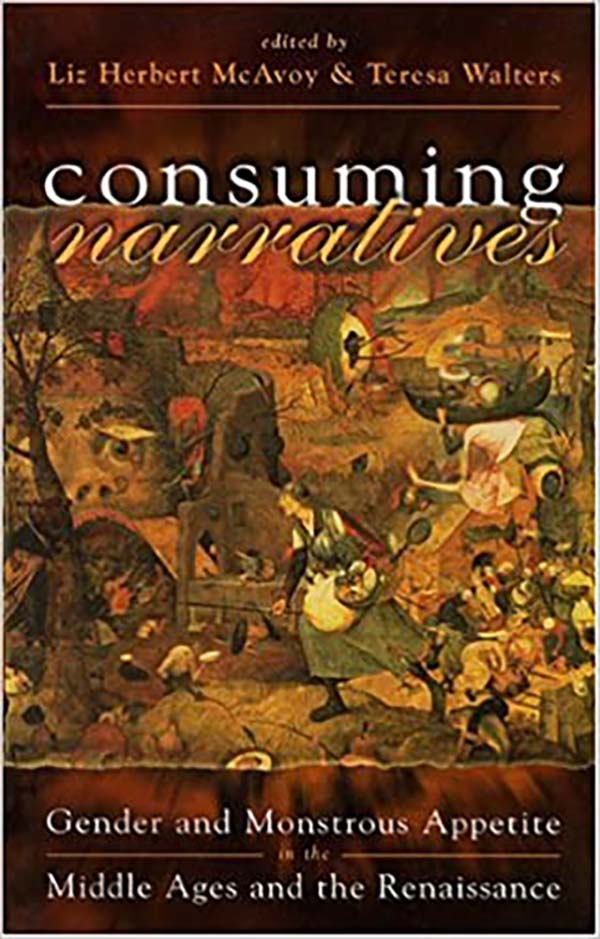
While moralists may stress the importance of the proper management of appetite, medieval and early modern narratives are full of images of monstrous and deformed appetites running out of control. Consuming Narratives examines the significance of these concepts, metaphors and narratives of appetite for understanding gender, politics, race and nation in the Middle Ages and the Renaissance. The essays in this wide-ranging collection consider appetite in relation to sexual and textual consumption, monstrous bodies and genders, races and nations. Each section is introduced by a leading academic in the field, while individual papers deal with a variety of texts, from the Revelations of Divine Love to Massinger's The Sea Voyage, and cover topics ranging from trade and colonialism to vampires, witchcraft and the sheela-na-gig figure. Consuming Narratives analyses representations of monstrous appetites, highlights the role of consumption within narrative practices and considers the ways in which appetites and ideas about them contributed to the production of textual, human and national bodies. It will be an essential book for all those interested in the intersections of gender, politics and narrative in the medieval and early modern periods.
I Sexual/Textual Consumption - Response to papers by Nicholas Watson (Professor of English and American Literature, Harvard University); I Diane Watt (Senior Lecturer in English, University of Wales, Aberystwyth) - 'Consuming Passions - Gender and Sexuality in Book VIII of John Gower's Confessio Amantis'; II Isabel Davis (University of York) 'Consuming the Body of the Working Man in the Later Middle Ages'; III Kimberly Anne Coles (Linacre College, Oxford) - 'Reproductive Rites - Anne Askew and the Female Body as Witness in the Acts and Monuments'; IV Teresa Walters (UWA) - '"Such stowage as these trinkets" - Trading and Tasting Women in Fletcher and Massinger's The Sea Voyage (1622); V Claire Jowitt (Lecturer in English, University of Wales, Aberystwyth) - '"Antipodean Tricks" - Travel, Gender and Monstrousness in Richard Brome's The Antipodes'; II Monstrous Bodies - Response to papers by Margo Hendricks (Associate Professor of Literature, University of California at Santa Cruz); I Emma L. E Rees (Lecturer in English, Chester University College of Higher Education) - 'Sheela's Voracity and Victorian Veracity'; II Bettina Bildhauer (Pembroke College, Cambridge) - 'Bloodsuckers - The Construction of Female Sexuality in Medieval Science and Fiction'; III Liz Herbert McAvoy (Lecturer in English, University of Wales, Aberystwyth) - '"Ant nes he him seolf reclus i maries wombe?" - The Anchorhold and the Redemption of the Monstrous Female Body'; IV Marion Hollings (Associate Professor of English, Tennessee State University) - 'Fountains and Strange Women in the Bower of Bliss - Eastern Contexts for Acrasia and her Community'; V Margaret Healy (Lecturer in English, University of Sussex) - 'Monstrous Tyrannical Appetites - "& what wonderful monsters have there now lately ben borne in Englande?"' III Consuming Genders, Races, Nations - Response to papers by Andrew Hadfield; I Ruth Evans (Senior Lecturer in English, Cardiff University) - 'The Monstrous Appetites of Albina and her sisters'; II Sue Niebrzydowski (teaches at the Universities of Warwick and Wolverhampton) - 'Monstrous (M)othering - The Representation of the Sowdanesse in Chaucer's Man of Law's Tale'; III Kirstie Gulick Rosenfield (assistant Professor of English, Utah State University) - 'Monstrous Generation - Witchcraft and Generation in Othello'; IV Sujata Iyengar (Assistant Professor of English, University of Georgia, Athens) - 'An Ethiopian History - Reading Race and Skin-Colour in Early Modern Versions of Heliodorus' Aithiopika'
Awdur(on): Liz Herbert McAvoy
Awdur(on): Teresa Walters